
Bach on a Möbius Loop
And other mathematical discoveries.

Last week at the library, I was reading a biography of J. S. Bach1 in my favorite nook in the nonfiction room. It wasn’t before to long that I realized it would be great blog material:
“For Bach…the concept that music formed a branch of the liberal arts quadrivium was still as valid as it had been for Johannes Kepler, who promoted the view that music mirrored the harmony of the universe.
Quadrivium. Excellent, I thought, and kept reading:
“Music, then, with its tradition mathematical underpinning, provided an especially rich field of operation for a composer who was increasingly infected with scientific curiosity, totally uninterested in ‘dry exercises in [musical] craftsmanship,’ but thoroughly committed to advancing ‘true music,’ which Bach defined as music that pursued as its ‘ultimate end or final goal…the honor of God and the recreation of the soul.’”
Yes! This is why music is categorized with arithmetic and geometry in the liberal arts, regardless of how it is thought of in the performance arts and elsewhere in the world.
Shortly after Bach’s death there was a flurry of writings about him, some deriding him and others extolling him. One compared him to Isaac Newton, saying that he had made the same quality of advances in musical theory that Newton had in physics a generation previously. If that is so, Bach went about it in a rather unconventional way. If he had a theory, he wrote a piece of music showcasing it. Why waste words on music when music is best explained in its own language?
According to the biography I’m reading, there was no “practical treatise” on fugal composition before Bach’s musical version, Die Kunst der Fuge (The Art of the Fugue). The first literary treatise on the subject , Abhandlung von der Fuge by Friedrich Wilhelm Malpurg, was based heavily off of The Art of the Fugue.
But I can’t see myself reading that book when I could listen to the original. (see video below)
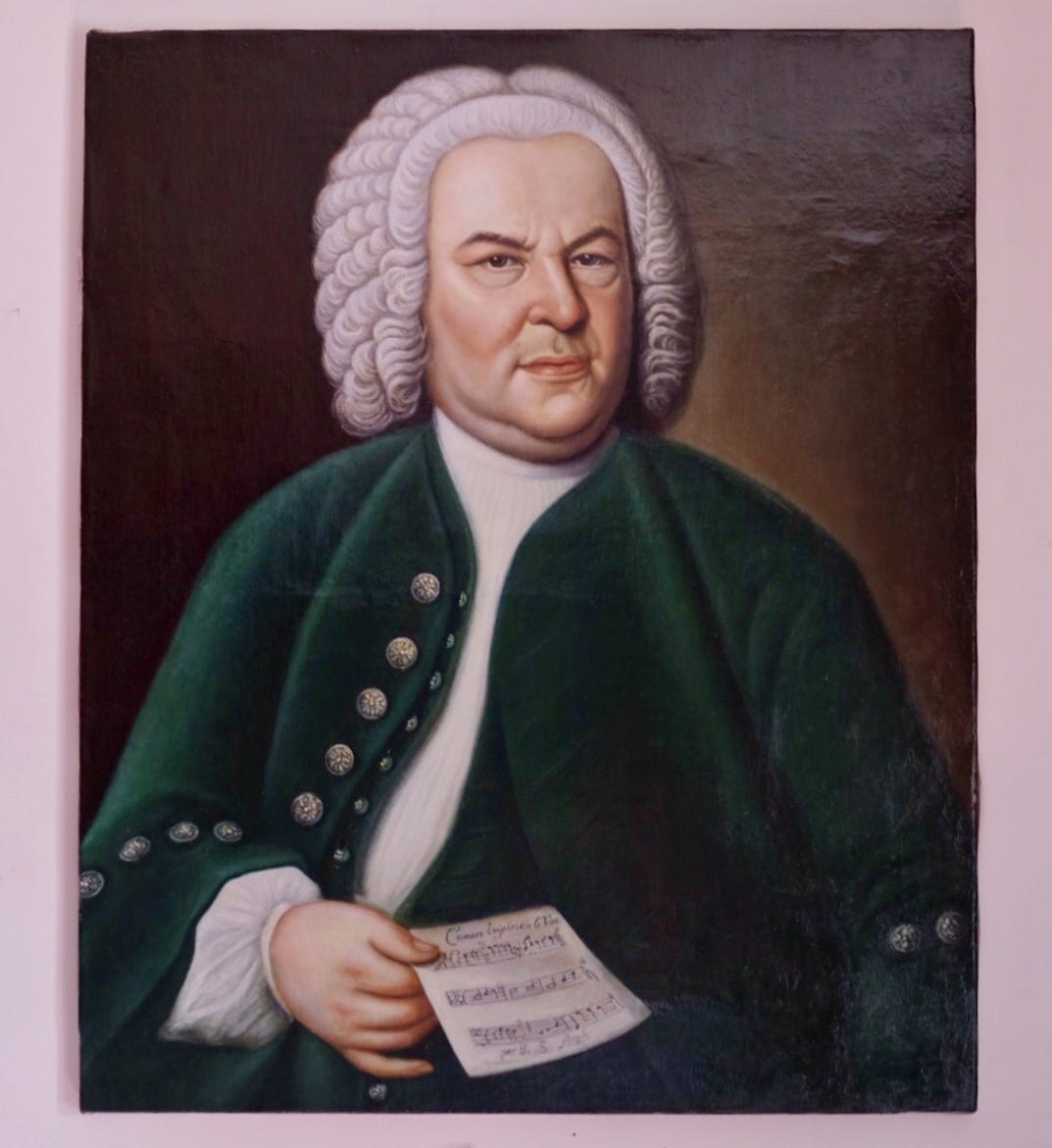
There is only one surviving painting of Bach that we know is him. Damaged paintings have been found that could be portraits of him, but we’ll never know since they all look like him now that they have been refurbished. In Bach’s portrait (the real one), he’s holding a scrap of paper that has one line of music, but it’s titled for six voices. He’s pretty much saying, “I know my counterpoint.” Musical theorists analyzed the little song to figure out what the other five parts would be. At first, they found a little more ten possible combinations, but over the last few years the list has mounted to more than 200! I guess we’ll never know what it was supposed to sound like unless the melody appears in one of his more completed works.
I’m about to get to the möbius loop I mentioned in the title. The king of Prussia heard that Bach was good at musical improvisations, so when he met Bach he asked him “on the spot to improvise a fugue on a given theme”2 The finished result was The Musical Offering, a series of canons, a ricercar and a trio sonata. They were all written like puzzles for the musicians to figure out. For example, this line (below) can be played backwards and forwards against itself.
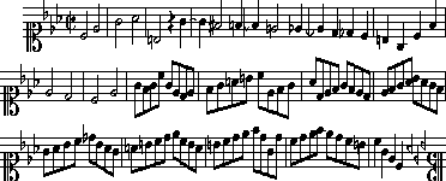
You can represent this by imposing the line of music on a möbius loop. Like Bach, I won’t try to explain this with words, because it’s music. Instead, you can see it in this video. If that is too confusing, or you want a better quality recording, check out The Netherlands Bach Society’s version on YouTube.
One of Bach’s students said that “geometry is necessarily of great benefit to music and the knowledge of the tones.” Geometry? was my first reaction. Why geometry, not arithmetic?
Möbius loop aside, there is still more geometry to be found in Bach’s music, such as fractal geometry in the Bourree of Cello Suite 3. The whole movement can be divided into three sections, two short and one long. The first part can be divided the same way, and the sections made from it can also be divided into sections of two short and one long. Since there’s a repeat sign, the image below represents both of the short sections.
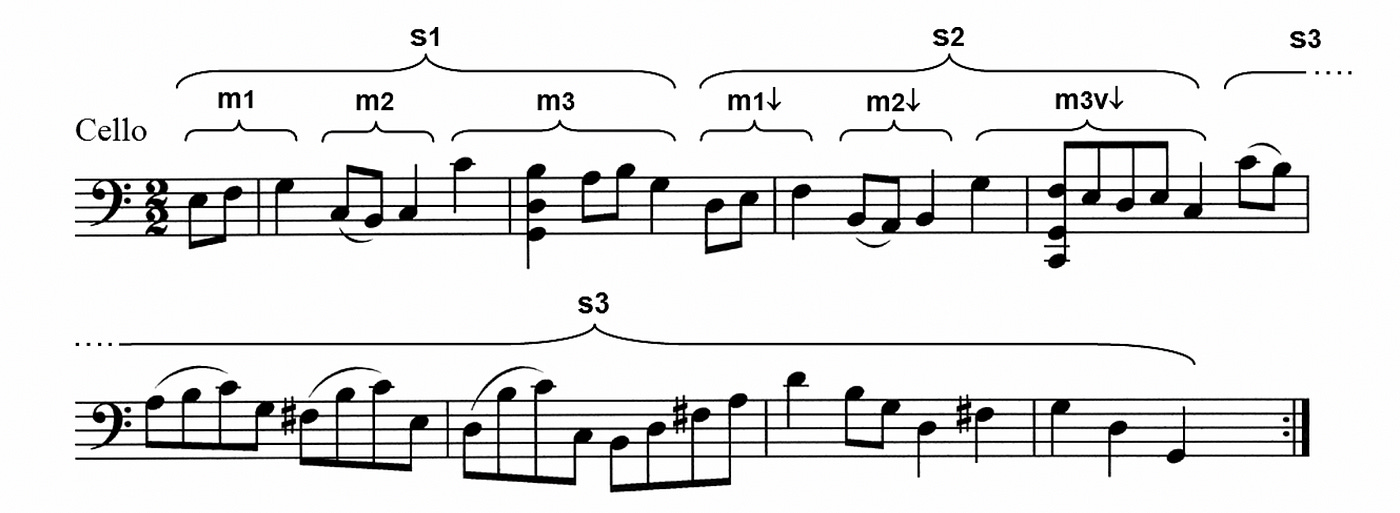
If you’ve ever had a music teacher tell you to never skip the repeats in Bach, here’s a reason why: you’ll mess up the geometry if you don’t.
Bach certainly isn’t all math and it’s a good thing because:
“…the end and ultimate cause, as of all music…should be none else but the glory of God and the recreation of the soul and mind. Where this is not observed, there is no real music but only a devilish blare and hubbub.” - J. S. Bach
The biography states that another crucial element of music is its ability to stir and mimic human emotions. This kind of reminds me of the subject of rhetoric in the trivium. Grammar and logic can give you the skills for rhetoric, but they’re less satisfying on their own. Geometry and arithmetic do kind of the same thing for music. Even astronomy, fitting together arithmetic and geometry to discover what is really happening in the heavens, can prepare you for making a world out of music. At first glance, music seems a little out of place, but it is the pinnacle of the quadrivium.
Finis
Works and People Sited
The Netherlands Bach Society on YouTube
Johann Sebastian Bach and the Mathematical Mind - Teora Music School
van Veldhoven, Jos
Johann Sebastian Bach The Learned Musician by Christoph Wolff
Johann Sebastian Bach The Learned Musician by Christoph Wolff
Source: The Netherlands Bach Society